The jacket with the tropical leaves — and why I grew fashion from mushroom mycelium
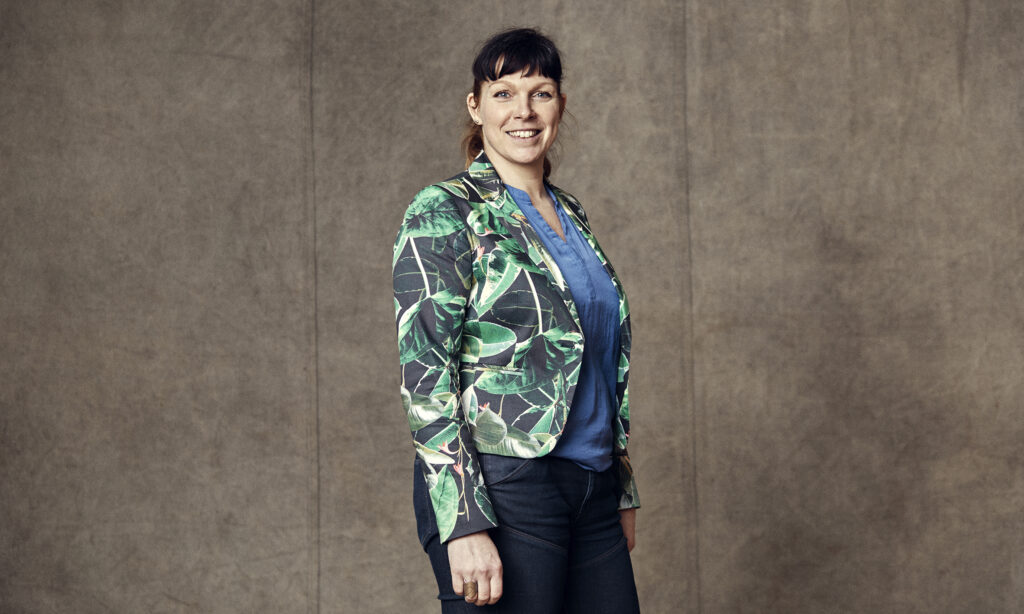
One jacket. Twenty years. The same feeling every time. The jacket has a black base covered entirely in tropical green leaves with small orange flower accents. It fits perfectly — which, as anyone who has spent decades in the fashion industry will tell you, almost never happens. It accentuates my body in exactly the right ways. And when I put it on in the morning before a presentation or an important event, something shifts. The feeling is not excitement, exactly. It is more specific than that. When I put on that jacket, I feel in control. Whatever happens, I can solve it.
I have worn it so many times over the past twenty-plus years — to presentations, to interviews, to events — that at a certain point I had to stop wearing it in public. The same jacket kept appearing in press photos and online coverage. For a fashion designer, being associated with a single garment is a particular kind of irony.
But here is what I notice every time I put it on: the story is in the fit, the pattern, and what those things do to how I carry myself. That is what fashion – or perhaps better style – actually is. Not logos. Not trends. The very personal, very physical experience of wearing something that was made — accidentally or deliberately — for you.
Think about your own favourite garment. Not what it looks like on a hanger. What it does to you when you put it on.
That feeling is what I have spent my career trying to understand — and trying to make available to more people, through better systems.
“When I put on that jacket, I feel in control. Whatever happens, I can solve it. That is what fashion actually does — at its best. Not decorate. Transform.”
What I saw in the factories — and what I could not prove
I spent ten years designing for fashion brands, ending at Tommy Hilfiger where I was responsible for a product line generating ten million euros in annual revenue. That experience taught me most of what I know about how the industry actually works — as opposed to how it describes itself. After ten years I started working as a consultant, bridging the gap between research and commerciality in fashion and textiles.
The sustainability conversations I sat in during the first years as a consultant were about cork buttons and natural dyeing. I understood the intention. But I kept asking myself: who wants to wear a garment that looks like it has already been washed a hundred times? Who genuinely cares about a cork button when the rest of the jeans is made from conventionally grown cotton, processed with chemicals, assembled in a facility you have never seen and cannot verify?
The factory visits were another education. Every facility I visited seemed almost suspiciously clean. The production lines always seemed to have the right brand’s garments running at exactly the moment we arrived. It gave me a nagging feeling — one I could not prove at the time — that these were example factories. That the actual production was contracted out, and contracted out again, and contracted out once more until you reached the price that made the margin work. Years later, this practice became news. Brands whose supply chains turned out to run through layers of contractors, each subcontracting to someone cheaper, until accountability became impossible to trace. My instinct had been right. I just had not yet found a way to change it.
And then there was the question that accumulated slowly, over years of designing more or less the same things each season: how many clothes do we have to make before it is enough?
The recycling bag that held a whole wardrobe
I visited a textile recycling facility in the Netherlands around fifteen years ago. The volumes they were receiving were already, at that point, more than they knew what to do with. The system for actually processing and reusing the material was not keeping pace with the volume of discarded clothing coming in.
What I remember most clearly is standing in front of the collection bags — large mesh containers filled with donated and discarded garments. Through the mesh, you could see exactly what was inside. Individual pieces were recognisable. A coat. A dress. Jeans. Items that had been someone’s wardrobe, now compressed together, waiting to be processed.
Seeing one or two recognisable garments through a recycling bag is charming, almost nostalgic. Seeing an entire wardrobe of them — pile after pile, bag after bag — is something else entirely. It is the physical weight of overconsumption made visible. And it has stayed with me ever since.
“Through the mesh bags at the recycling facility, you could see whole wardrobes. One recognisable coat is nostalgic. An entire wardrobe of them, pile after pile, is the weight of overconsumption made physical.”
The colleague who wore something different every day
At Tommy Hilfiger I had a colleague — I will call her K. — who wore something different to work almost every single day. I almost never saw her in the same outfit twice. One day I asked her directly: didn’t she care about sustainability? She thought about it and said yes, she did care. And then she said: but I just want to have the clothes. To have more choice.
I had been trying to convince people to buy less for years. The more I tried, I noticed, the less open people became to the conversation. K.’s honesty was clarifying. She was not uninformed or indifferent. She simply wanted what fashion had always offered: variety, self-expression, the daily pleasure of choosing who to be.
I realised that afternoon that I had been preaching to the wrong choir — and that perhaps I should not be preaching at all. The question was not how to make people like K. want less. The question was: how do you give people the choice they genuinely want, without the environmental cost that currently comes with it? How do you lure people into sustainability without asking them to think about it at all — by simply offering great design?
Nature’s own solution
The answer I kept returning to was biological. Nature has its own consumptive cycles. Every autumn a tree sheds its leaves — not as waste, but as part of a closed loop. The leaves decompose, return nutrients to the soil, and the tree grows a new set. Nothing is lost. Nothing accumulates. Could fashion work the same way? Could we make garments that were grown, worn, and composted — garments designed for a lifecycle rather than fighting against one?
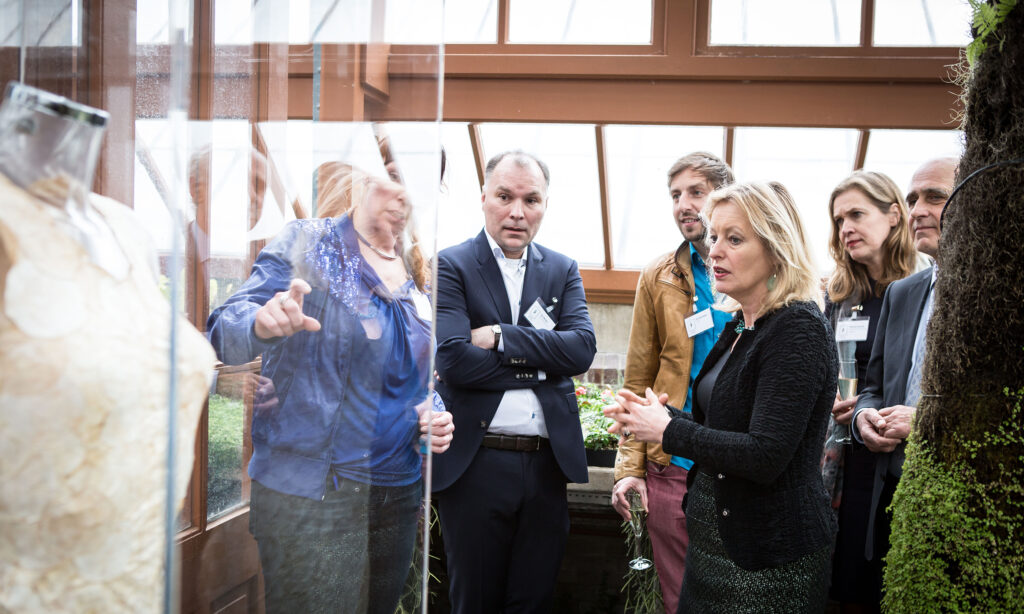
This was the question that led me to found NEFFA and develop MYCOTEX — the world’s first compostable textile combined with a 3D moulding technique for personalised, zero-waste fashion. The material is grown from mycelium, the root network of mushrooms. It is applied directly onto a body-specific mould, dried, and worn. No spinning, no weaving, no cutting, no sewing, no intercontinental transport. A garment from concept to completion in days, made to your exact measurements, designed to return to the earth when you are done with it.
I was not trying to make the next cotton or the next leather. I was trying to make something genuinely new — with its own look, its own texture, its own logic. The industry, for years, kept asking me to make it smoother, more familiar, more like what they already knew how to sell. I kept saying no. I wanted to add to the material palette of fashion, not copy what was already there.
The woman who did not want to wear petroleum
My first proof-of-concept was a simple dress made from mycelium pieces grown in Petri dishes. I exhibited it at the mycelium exhibition “Fungal Futures” in the University Museum Utrecht in 2016 and went back several times to watch people’s reactions. I asked one woman whether she would wear the dress. She said yes — she thought it was lovely. Then I asked if she knew what the material was. She did not.
When I explained it was made from mycelium — the root of mushrooms — she hesitated. A strange material, she said. She was not sure.
So I told her what her own clothes were made from. That most fashion is made from petroleum-based synthetic fibres. That she was, at that very moment, wearing oil.
The hesitation disappeared. Mycelium suddenly seemed entirely reasonable. Why would anyone choose to wear petroleum when there was an alternative?
That conversation has anchored everything I have done since.
“She was not sure about wearing mycelium. So I told her what she was already wearing: petroleum. The hesitation disappeared immediately. Why would anyone choose oil when there is an alternative?”
Personal fit is not a luxury. It is the point.
I have always had difficulty finding well-fitted clothes in my own style — particularly jackets. The fashion industry’s standard sizing was built on a narrow template that does not reflect the actual range of human bodies. For most people, buying clothes means accepting a compromise: something that fits well enough, in the right general direction, if you adjust your expectations of what “fitting” means.
This is personal for me. And it is also, I believe, one of the most under-explored dimensions of sustainable fashion. The Dutch National Wardrobe Audit of 2025 found that the number one reason people discard garments is that they no longer fit. The number one reason they love a garment is that it fits perfectly. The industry has known this for decades and has not solved it — because the solution requires a different production architecture, not just a wider size range.
Body scanning makes that different architecture possible. When you start with an accurate digital model of a person’s body, you know exactly how much material to grow, exactly what mould dimensions to set, exactly what shape to produce. Custom fit stops being a luxury and becomes the default.
I have a secret television obsession that I think explains this better than any technical description: Say Yes to the Dress. I am genuinely moved by it every time. The moment when a person — who has been trying on dress after dress that almost works — puts on the right one, something visibly changes in how they hold themselves. That transformation is not superficial. It is the power of a garment that was made for you, or that feels like it was. That is what I am trying to make available to everyone.
What comes next in this series
This is the first article in a series of ten. Over the coming months I will share what I have learned — from twenty-five years at the intersection of fashion, materials, and systems thinking — about why the industry is where it is, where it is going, and what a genuinely different future might look like.
Not an ideal future. A real one. Designed for how people actually behave, not how we wish they would.
Ready to build the material future?
I work with brands, research organisations, and investors serious about making the transition real — not just talking about it.
Let’s Collaborate