Textile as Fast Media: a framework for fashion that actually works
The idea that made me nervous to share
Every time I have presented an idea that challenges the orthodoxy of sustainable fashion, I have been nervous beforehand. When I founded MYCOTEX on the premise that fast fashion is not going away and we should design for it rather than against it, I knew it would land badly in some rooms. It did. The accusation was predictable: you are giving people permission to keep consuming.
What I am about to propose in this article provoked the same reaction in me when I first followed the logic to its conclusion. So let me be clear about what I am and am not saying, because this framework has been misread before, and I would rather address that directly.
I am not saying fast fashion is good. I am not celebrating disposability. I am saying that if we want to design a fashion future that works for the majority of human beings – not just the committed minority who already prioritise sustainability – we need to stop designing for an ideal that does not exist and start designing honestly for the reality that does.
That requires a new framework for thinking about value in fashion. I call it post-idealist textile values. It is built on seven observations about how people already use clothes. Named, made explicit, and designed for.
The Instagram post model of fashion
Here is an observation that I think has not been taken seriously enough: garments already behave like social media posts. They are worn briefly, photographed, shown to an audience, and then either archived or discarded. Their meaning is often tied to a specific moment: an event, a mood, a version of who you were at a particular time.
This is not a corruption of fashion. For many people, especially younger ones, it is what fashion is. And rather than lamenting it, I think there is something genuinely interesting in following that logic all the way through. If this is how clothes are actually experienced, what does it mean to design well for that experience? What does value look like inside a short lifecycle rather than despite it?
This is the question I have been sitting with, and the framework below is my current best answer.
Seven new values for a post-idealist fashion reality
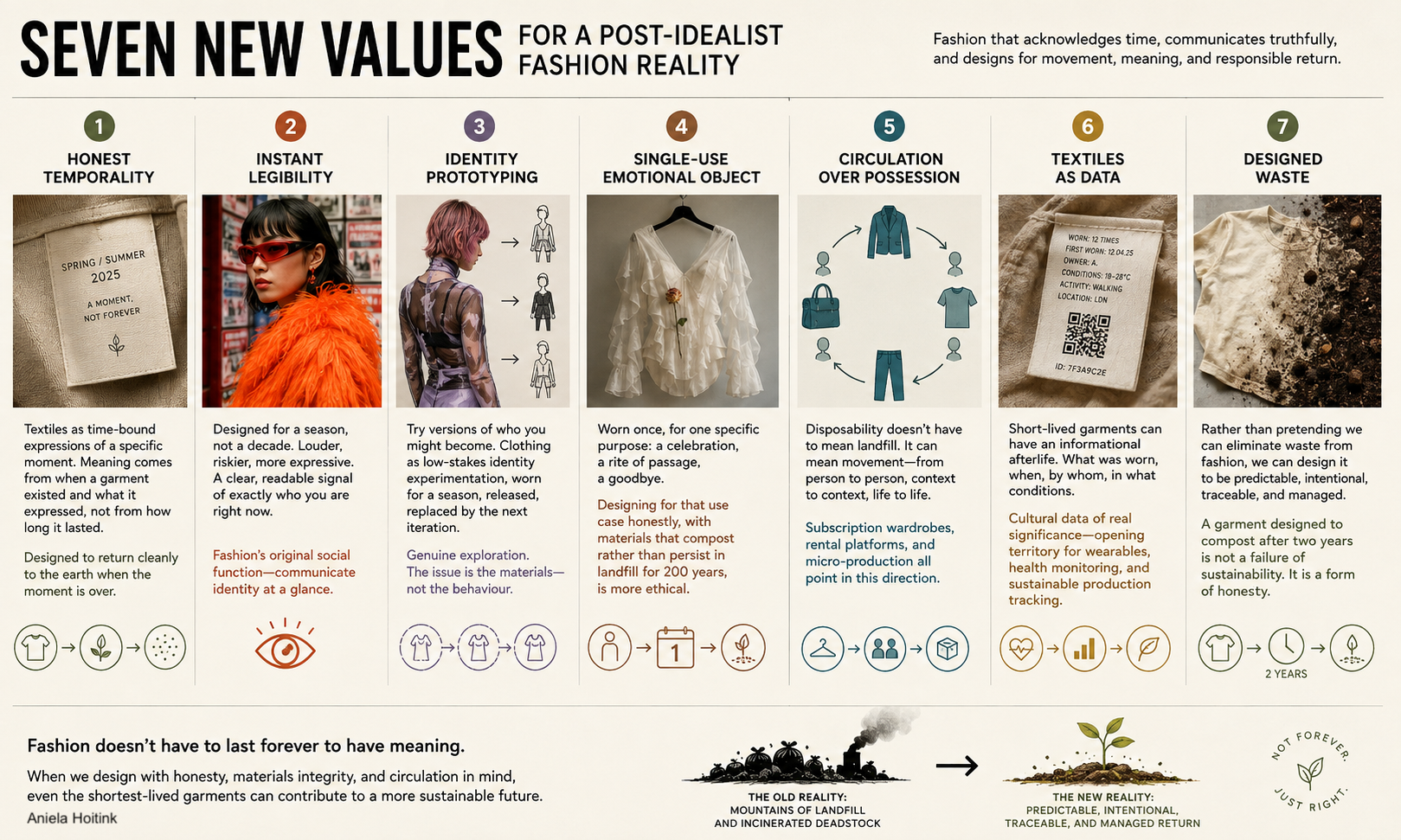
The first is honest temporality. Textiles as time-bound expressions of a specific moment. Meaning comes from when a garment existed and what it expressed, not from how long it lasted. This is already how many people experience fashion. The question is whether we design systems that acknowledge it honestly, with materials that return cleanly to the earth when the moment is over.
The second is instant legibility. If a garment is designed for a season rather than a decade, it can be louder, riskier, and more expressive. It does not need to be versatile or timeless. It can be a clear, readable signal of exactly who you are right now. Fashion’s original social function – the ability to communicate identity at a glance – compressed into a more honest form.
The third is identity prototyping. People do not always want to commit permanently to a self. They want to try versions of who they might become. Clothing as low-stakes identity experimentation, worn for a season, released, replaced by the next iteration, is not necessarily shallow. It can be a genuine form of personal exploration. The problem is not the behaviour; it is the materials underneath it.
The fourth is the single-use emotional object. This one is uncomfortable but accurate. Some garments are worn once, for one specific purpose: a celebration, a rite of passage, an event. Designing for that use case honestly, with materials that compost rather than persist in landfill for two hundred years, is more ethical than pretending the garment will be worn again.
The fifth is circulation over possession. Disposability does not have to mean landfill. It can mean movement; from person to person, context to context, life to life. The emerging models of subscription wardrobes, rental platforms, and micro-production all point in this direction.
The sixth is textiles as data. Short-lived garments can have an informational afterlife. What was worn, when, by whom, in what conditions. This is cultural data of real significance, and it opens interesting territory for wearables, health monitoring, and sustainable production tracking.
The seventh, and the one most central to my own work, is designed waste. Rather than pretending we can eliminate waste from fashion, we can design it to be predictable, intentional, traceable, and managed. A garment explicitly designed to compost after two years is not a failure of sustainability. It is a form of honesty that the current system, with its mountains of landfill and incinerated dead stock, cannot claim.
“A garment designed to compost after two years is not a failure of sustainability. It is more honest than a garment designed to last twenty years that ends up in landfill after seven wears.”
The two-layer wardrobe
Putting this together with everything I have argued in previous articles, the wardrobe of the future I am designing toward looks like this.
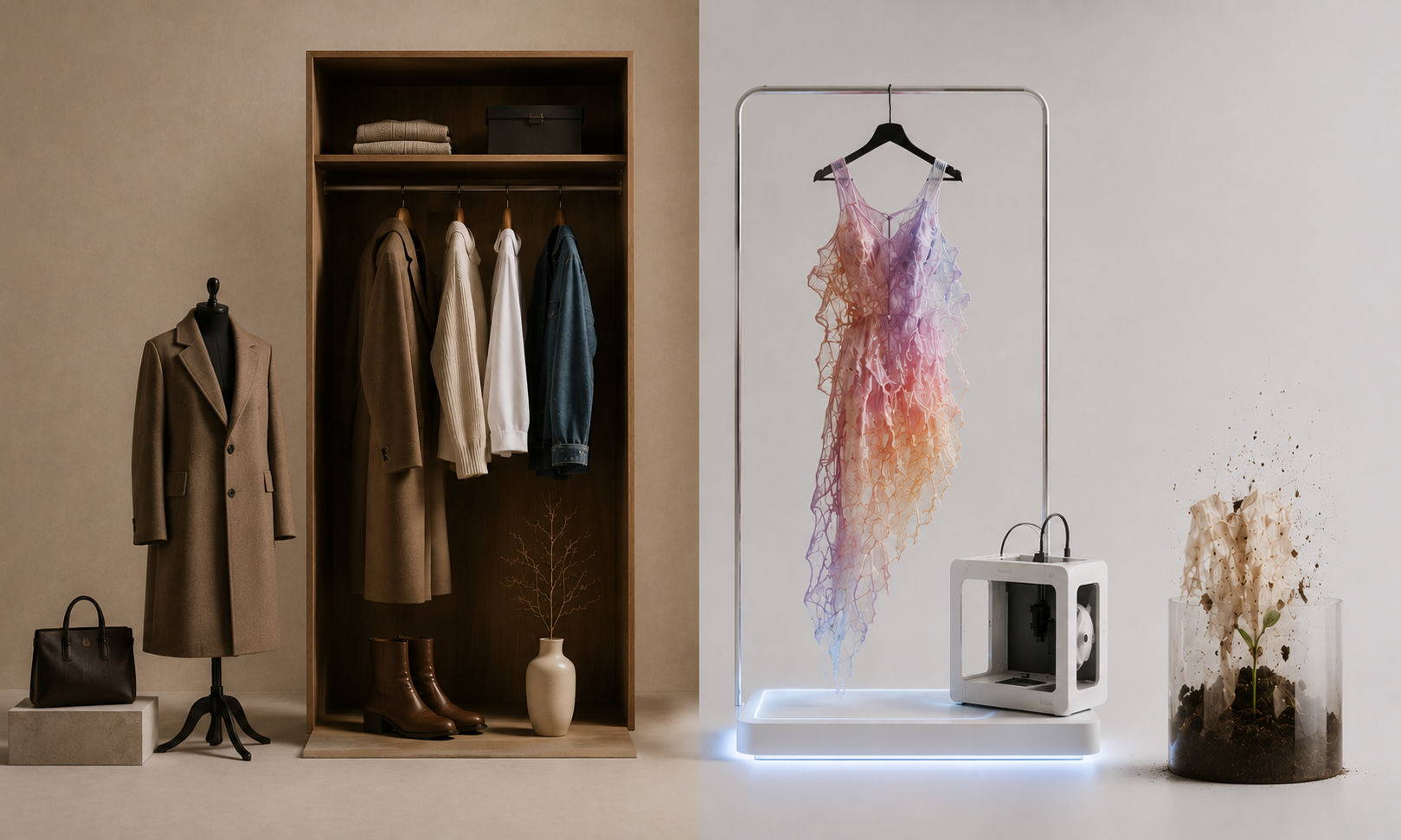
One layer is slow: genuinely high-quality, long-lived pieces. Well-made, designed to repair, in styles that are personal (style) rather than seasonal (fashion). These are the garments that carry real emotional weight. Garments that have been chosen carefully, that earn their place over years of wear. The conventional supply chain, properly reformed, can serve this layer. The work on durability, repairability, and truly circular materials belongs here.
The other layer is fast: expressive, moment-specific, occasion-led. Designed explicitly for a short lifecycle and a clean return. Not cheaply made out of indifference to the planet, but elegantly made out of genuine respect for how these garments are actually used. Grown rather than woven. Moulded rather than sewn. Produced on demand, without overstock, from materials with a designed end-of-life, and with closed-loop in mind from the start.
High-tech fast fashion and low-tech slow fashion, coexisting. Not as a compromise, but as an honest design response to how human beings actually live.
The sustainable fashion industry has spent a decade designing for a wardrobe of thirty-three neutral pieces. The human race has been designing for something quite different. It is time to close that gap.
What this means beyond fashion
Before I move to the practical implications, I want to note that this framework applies well beyond garments. The same logic, design for actual use, honest temporality, materials with designed end-of-life, applies to footwear, interior, automotive, and any other product category where flexible, shaped materials meet relatively short use cycles.
Interiors in hospitality, retail, and co-living spaces are refreshed regularly. They are effectively fast fashion for spaces. And yet they are made from materials that will persist in landfill for centuries. The post-idealist framework I am describing here applies directly to those contexts, and arguably with less cultural resistance, because interiors do not carry the same moral weight in public conversation that fashion does.
This is part of what I am exploring at AURITA: the same supply chain logic, applied across multiple industries, wherever the combination of local production, closed-loop materials, and on-demand manufacturing creates genuine value.
Ready to build the material future?
I work with brands, research organisations, and investors serious about making the transition real, not just talking about it.
Let’s Collaborate