Why your brain is not the problem —but it is part of the equation
The conversation that ended my sustainability campaigns
For years I tried to convince people to buy less. I gave talks about it. I made the arguments about environmental impact. I believed in the power of information to change behaviour.
Then I had a conversation with a colleague at Tommy Hilfiger — the woman I called K. in my last article — who wore something different to work almost every single day. I asked her whether she cared about sustainability. She said yes, genuinely. And then she said: but I just want the clothes. I want more choice.
The more I tried to convince people, I had noticed, the less open they became. Preaching creates resistance. And I was preaching to people who already knew. K. was not ignorant of the problem. She simply wanted what fashion had always offered — variety, self-expression, the daily pleasure of being able to choose.
What I took from that conversation was not resignation. It was a different kind of ambition: stop trying to change what people want, and start redesigning the systems that deliver it. But to do that well, I needed to understand why behaviour change is so difficult — not as a moral failing, but as a structural reality.
What Maslow actually tells us about sustainable fashion
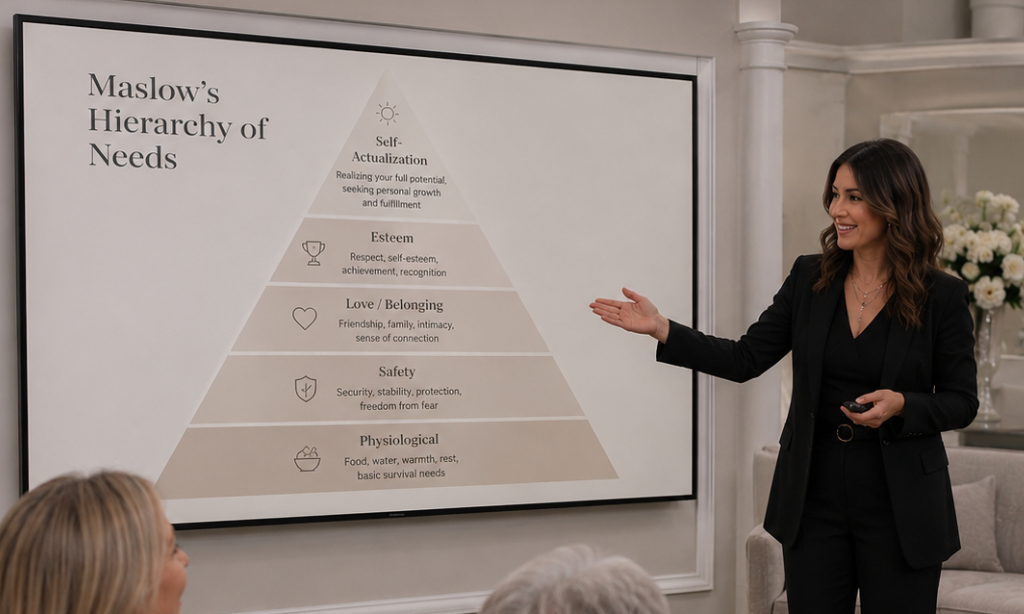
Abraham Maslow’s hierarchy of needs is one of those frameworks that everyone has heard of and almost nobody applies honestly. In the context of fashion, it reveals something the industry consistently ignores.
The hierarchy moves from the most basic needs — food, warmth, physical safety — through belonging, esteem, and eventually toward aesthetic experience and self-actualisation. The critical principle is not the hierarchy itself but what it implies about decision-making: when lower-order needs are not met, higher-order considerations cannot dominate.
A person managing genuine financial stress — worried about rent, food, their children’s needs — is not in a cognitive position to weigh the environmental credentials of their clothing choices. This is not a character failing. It is basic neuroscience. Chronic stress impairs the prefrontal cortex, the region responsible for long-term thinking, impulse control, and weighing competing values. Scarcity — of money, of time, of mental space — narrows what researchers call “mental bandwidth.” The capacity to process new information and make thoughtful decisions physically decreases. This can happen to anyone.
For sustainable fashion, this means that the people most targeted by sustainability messaging — lower-income consumers who drive volume in fast fashion — are precisely the people least equipped, neurologically, to act on it. Asking them to pay more, research supply chains, and think about end-of-life disposal requires cognitive resources that scarcity has temporarily taken offline.
“Scarcity captures the mind. The stress of not having enough takes over the capacity needed to think about anything else — including sustainable choices. This is not weakness. It is how human brains work under pressure.”
The esteem need that fashion actually serves
There is a fourth level in Maslow’s hierarchy that is particularly relevant to fashion and almost never discussed in sustainability circles: esteem. The need to feel respected, valued, and accepted by others. The need for status, recognition, and a sense of belonging to groups we admire.
Clothing is one of the primary tools through which this need is met. A young person in a city buying from a fast fashion platform is not failing to care about the planet. They are managing real social pressures with limited financial resources. They need to be seen as current, relevant, and socially connected — and fast fashion offers that at a price that works.
Sustainable fashion, for the most part, addresses aesthetic needs — upper levels of the hierarchy. It asks consumers to care about ethics, systems, and futures. But esteem is more urgent than aesthetics. Belonging is more urgent than beauty. Until sustainable fashion can also meet the esteem need — can make the person feel good about themselves in the eyes of people they care about — it will remain a niche choice for those who are already privileged enough to have their esteem needs met through other means.
The Dutch National Wardrobe Audit of 2025 confirmed this with data. The number one reason people love a garment: comfort and fit (43%). Style and aesthetics: 16.6%. Sustainability: 1.3%. People are not wrong to prioritise the way they do. The industry has simply not yet built sustainable options that also deliver on the things people actually value.
Say Yes to the Dress — and what it teaches us about enclothed cognition
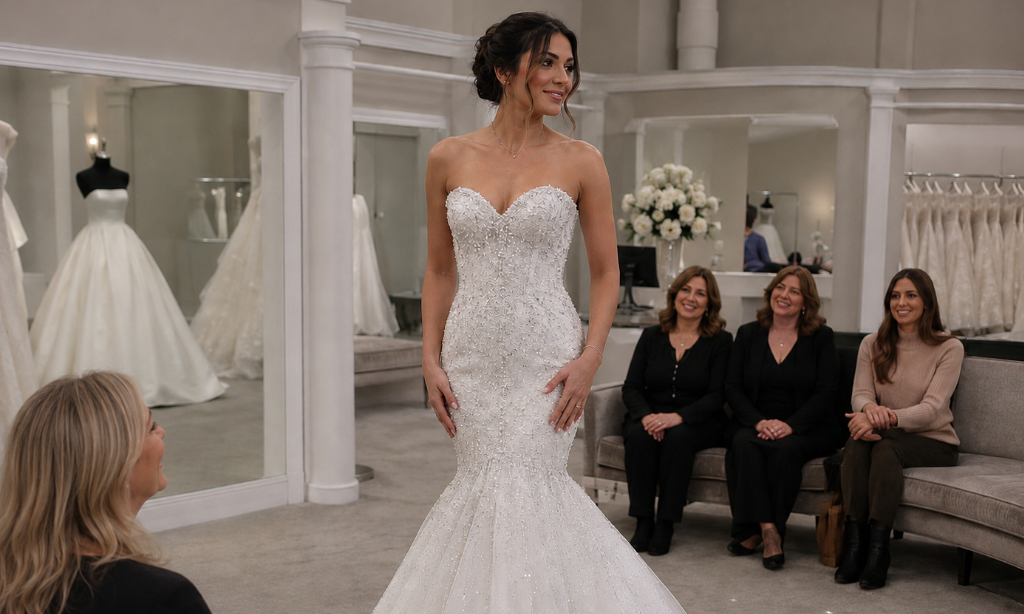
I have a television habit I am slightly embarrassed to admit: I watch Say Yes to the Dress. Regularly. I find it genuinely moving.
The moment I keep watching for is when someone — after trying on dress after dress that almost works — puts on the right one. Something changes immediately. The posture shifts. The expression opens. The person standing in the mirror is recognisably, visibly more themselves.
This is not television drama. This is a well-documented psychological phenomenon called enclothed cognition, described by researchers Adam and Galinsky in 2012. The clothes we wear influence not just how others see us but how we think, feel, and perform. Participants who wore a white lab coat associated with doctors made fewer errors on attention tasks than those in street clothes. The symbolic meaning of the garment, combined with the physical experience of wearing it, altered cognitive performance.
This is why the feeling I described in my first article — the jacket with the tropical leaves, the sense of being in control — is not vanity. It is real. Clothing that fits well, that carries the right associations, that says something accurate about who you are, delivers something functional. It changes how you move through the world.
Any sustainable fashion system that dismisses or devalues this dimension will not succeed. It is asking people to give up something that genuinely matters to them. The goal should be to build systems that deliver that same feeling — of fit, of rightness, of self-expression — through fundamentally better processes.
“I watch Say Yes to the Dress because the moment when the right dress goes on is not television drama. It is the power of fashion at its best — visible, immediate, and real. That is what I am trying to make available to everyone.”
The endowment effect and the psychology of the full closet
There is one more psychological phenomenon worth naming, because it explains something that puzzles a lot of people: why do we own so many clothes we never wear, and why is it so hard to let them go?
The endowment effect, identified by economist Richard Thaler, is the tendency to value things more highly simply because we own them. The same garment is worth more, psychologically, to its owner than to anyone else. This is not about the garment’s quality or usefulness. It is about the cognitive weight of ownership.
In the wardrobe, this means that discarding a garment feels like a loss — even one we have not worn in three years. Our brains weigh the concrete cost of letting go more heavily than the abstract benefit of a cleaner, calmer wardrobe.
What is interesting is that the endowment effect is strongest for garments with emotional or identity associations. The pieces we cycle through quickly — the fast fashion haul that felt exciting in the shop and flat in the wardrobe — tend to be the ones we never fully bonded with. Because we bought them quickly, at low cost, without the process of consideration or making that creates genuine attachment.
This suggests something counterintuitive: the route to valuing clothes more is not necessarily spending more. It is being more involved in their creation. Co-design, personalisation, the experience of choosing something specifically for yourself — these create the psychological ownership that turns a purchase into a possession.
Designing for real psychology
What does all of this mean in practice?
It means that sustainable fashion cannot rely on consumer virtue as its primary mechanism. The people most in need of affordable clothing are least positioned to prioritise sustainability. The people already engaged with sustainable fashion show rebound effects that offset their gains. And the psychological forces driving clothing acquisition — esteem, identity, emotional regulation, social belonging — are not going to be educated away.
The only approach that works at scale is designing systems that are sustainable by default. Where the efficient, affordable, well-fitting option is also the one with the lowest environmental impact. Where consumers do not have to be experts in supply chain ethics to make a good decision — because the supply chain itself has already made that decision.
That is what I have spent the last decade building. Not how to make consumers more virtuous. How to make the system more honest.
Ready to build the material future?
I work with brands, research organisations, and investors serious about making the transition real — not just talking about it.
Let’s Collaborate