Fast Fashion is not going away. So what do we do with that?
The statement nobody wants to make at a sustainability conference
Fast fashion is not going away. It may, in fact, be getting faster.
I know how that lands in certain rooms. I have been in those rooms — presenting at sustainability conferences, sitting on panels about circular fashion, talking to brands about material innovation. The assumption in most of those conversations is that fast fashion is the problem to be solved, the behaviour to be corrected, the habit to be broken.
I used to think that too. I spent years trying to convince people to buy less. The more I tried, the less effective it was. Eventually I had a conversation with a colleague — a thoughtful, informed woman who genuinely cared about sustainability — who told me plainly: she just wanted the clothes. She wanted choice. She was not going to stop.
That conversation changed how I work. Not because she was right to consume the way she did, but because she was honest about what the industry was offering and what people were actually taking from it. If we want to change fashion, we have to start from that honesty — not from a version of consumers we wish existed.
Two supply chains, not one
Before I go further, I want to be precise about something that often gets lost in these debates. There are effectively two fashion supply chains that need to change — and they need to change in different ways.
The first is the conventional supply chain: quality materials, garments designed to be worn many times, products that could and should last years. This supply chain needs to become cleaner, more transparent, more circular. The work being done on better materials, ethical production, and improved dyeing processes all matters here. These garments deserve that investment because they will be worn again and again.
The second is the fast fashion supply chain: garments worn a handful of times, purchased for a moment or a season, discarded and replaced. This supply chain also needs to change — but the answer is not to make it slower. It is to make it shorter, more local, more closed-loop, and based on materials designed to return to the earth. You do not fix this supply chain by adding sustainability credentials to the label. You fix it by redesigning the architecture entirely.
My work has focused on that second supply chain — not because I think fast fashion is good, but because I think pretending it will disappear is not a strategy.
“There are two supply chains in fashion. One needs to be cleaner. The other needs to be completely rebuilt. Applying the same solution to both is why so much sustainability effort in fashion fails to scale.”
The second-hand paradox
The innovation most celebrated in sustainable fashion circles right now is the second-hand market. Platforms like Vinted, Depop, and Vestiaire Collective have made resale mainstream. That is genuinely valuable. But the story being told about what second-hand achieves does not match the evidence.
A 2025 study by researchers Peleg Mizrachi and Sharon found that second-hand fashion consumers exhibit fast fashion behaviours: buying frequently, discarding within months, treating resale platforms as another source of novelty rather than a sustainable alternative. More than a third of their respondents had disposed of garments within a year. Nearly fifteen percent within a single month.
The mechanism is well understood. Low prices reduce the psychological barrier to buying. Fast inventory turnover creates urgency. And the belief that second-hand is inherently low-impact gives people permission to acquire more — the rebound effect. Vinted’s own data suggests that only around a third of purchases on their platform actually replace what would have been a new buy. The rest are additional consumption.
This is not an argument against second-hand markets. It is an argument against the story we tell ourselves about them. Resale alone will not fix an overproduction problem. It may, in some configurations, make it worse.
The cork button problem
I want to tell you about something I observed repeatedly during my years working inside conventional fashion industry. The sustainability initiatives that got traction were almost always aesthetic — cork buttons, naturally dyed fabrics, recycled packaging. Visible gestures. Things that could be photographed for a campaign.
At that time, nobody asked the harder question: who actually wants to wear a garment that looks like it has already been washed a hundred times? Who cares about a cork button if the rest of the jeans is made from conventionally grown cotton, assembled in a facility three subcontracts away from anyone with accountability?
I am not dismissing those efforts. But they were, in the language of systems thinking, interventions at the symptom level rather than the cause level. They made the existing supply chain slightly less bad without questioning whether the supply chain itself was the right architecture for a sustainable future.
What I kept looking for — and eventually started building — was something at the cause level.
The AI shopping revolution and what it means
The next wave of fashion technology is not going to slow consumption. It is going to accelerate it.
Zara has already cut its e-commerce production timelines from eleven days to forty-eight hours using AI tools. Virtual try-on, AI personal stylists, wardrobe management apps that blur the line between “use what you have” and “buy something new” — all of these are being built, right now, to make the acquisition of clothing faster, easier, more personalised, and more ubiquitous.
Meanwhile, at the production end, automated “dark factories” are emerging — facilities running twenty-four hours a day with no human workers on the floor, controlled by AI and robotics. One facility in Xinjiang launched recently with five thousand looms running simultaneously and zero production staff. The strategic logic is explicit: remove humans from the process, increase output, reduce cost, eliminate labour accountability concerns.
I am not describing these developments to alarm you. I am describing them because they will happen whether the sustainable fashion industry engages with them or not. The question is whether we help shape what they become, or leave that to others.
“The next wave of fashion technology will make acquisition faster, cheaper, and more seamless. That is the world we are designing for. Not because it is ideal — but because it is real.”
Looking outside fashion for solutions
One of the habits I have developed over many years of working on innovation is looking at other industries for technologies and processes that might apply to fashion. The solutions to fashion’s problems are rarely going to come from fashion alone.
Spraying liquid materials — a technique used in industrial manufacturing — became the basis for how MYCOTEX is applied. Liquid fermentation for growing biomass was already a proven, scalable technology used by biotechnology companies for entirely different purposes. I did not invent either of these processes. I combined them differently.
Years ago, before MYCOTEX, I used plumbing pipes from a hardware store to construct the middle sections of tutu-shaped lighting fixtures for a Sleeping Beauty installation. The pipes were perfect — structurally, dimensionally, economically. Nobody in the art or fashion world was using them for that. They were just sitting in the plumbing aisle.

I can walk through a hardware store and see the fashion industry. I think more innovators in this space need to develop that habit. The solutions are often already proven and scalable — they are just in a different aisle.
What a genuinely different supply chain looks like
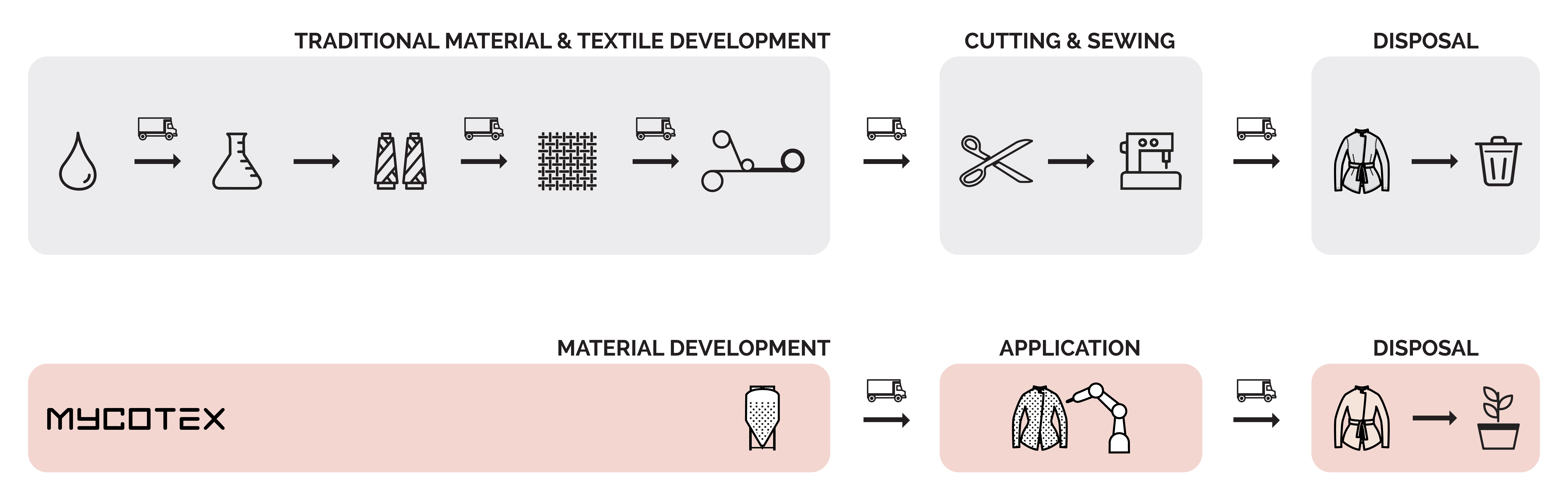
The MYCOTEX supply chain is the clearest example I can point to of what “different architecture” means in practice. No spinning. No weaving. No cutting. No sewing. Material grown in a factory from mycelium, applied to a body-specific mould, dried into a finished seamless garment. Water use at 0.5% of conventional cotton. No pesticides, no chemicals, no intercontinental transport. Produced on demand, to your measurements, in days rather than months. Currently used to create interior products.
This is not a marginal improvement on the existing system. It is a different system — one that happens to produce better results environmentally because it was designed differently from the start, not because sustainability credentials were added afterward.
Another system is developed by Klarenbeek and Dros. The studio has established the ‘Seaweed Circle”, a local production chain starting with the propagation and cultivation of seaweed embryos and ending with the production of Seaweed based biopolymers, ‘Weedware’. Resulting in CO2-binding and biocompatible materials that restore ecology, stimulate biodiversity and break with the current destructive cycle of production.
These are not the only possible new supply chains. They are examples of what becomes possible when you ask: what is the minimum required to create a beautiful, well-fitting product? And then let go of everything in between.
The wardrobe of the future — both layers
I believe the future wardrobe has two layers, and that sustainable fashion needs to serve both of them honestly. One layer is slow: timeless pieces, high quality, designed to last years, made to repair and rewear. The conventional supply chain, done properly, can serve this layer. The work being done on durability, repairability, and circular materials belongs here.
The other layer is fast: expressive, moment-specific, seasonal, affordable. This layer will not disappear through education or regulation. But it can be transformed — through new supply chains that produce only what is needed, from materials that return cleanly to the earth, locally, without overproduction or deadstock.
High-tech fast fashion and low-tech slow fashion, coexisting. Not as a compromise, but as an honest acknowledgement that different garments serve different human needs.
Ready to build the material future?
I work with brands, research organisations, and investors serious about making the transition real — not just talking about it.
Let’s Collaborate