We lost the value of clothing. Here is what I think we can do about it
The colleague who stopped my sustainability campaigns
I have already mentioned my colleague K. in this series, the woman at Tommy Hilfiger who wore something different to work almost every day, who cared genuinely about sustainability, and who told me plainly that she simply wanted more choice and was not going to change.
What I have not yet told you is what happened in me after that conversation. Not immediately, but over weeks and months of sitting with it.
I had been working for years on the premise that the problem was consumer behaviour. That if people valued their clothes more, bought less, chose better, the fashion industry would have to respond. The more I tried to make that case, in conversations, in presentations, to colleagues like K., the more I noticed that the people most open to the message were already converted, and the people who needed to hear it most were the least receptive. Preaching creates resistance. And I was preaching.
K.’s honesty unlocked something. The problem was not that she did not value her clothes. The problem was that the system had been deliberately designed to make her clothes not worth valuing; cheap enough to replace, plentiful enough to discard without loss, produced at such distance that no relationship between maker and wearer was possible.
The question was not how to make K. want less. It was: how do you design a system where the clothes people want are also worth keeping? Where great design and genuine sustainability are the same thing, not competing options?
What cloth used to be worth
To understand how much value we have lost from clothing, you have to understand what textiles once were.
Before industrialisation, cloth was genuinely scarce and genuinely precious. In many cultures it functioned as currency: traded, inherited, stored as wealth. Specific fabrics and dyes were restricted by law to particular social classes. The labour required to produce even a simple length of fabric was immense: spinning, weaving, finishing, all by hand, all representing hours of skilled work made visible in the object.
Beverly Gordon, in her study of textile history, makes a point that I think about often. Textiles are uniquely powerful objects because they combine intimacy, labour, portability, and symbolism in a way almost nothing else does. They touch the skin. They carry the evidence of the time and skill that made them. They move across generations and carry meaning with them.
That value did not disappear because people stopped caring. It disappeared because the system made it impossible to sustain. When cloth becomes cheap, abundant, and made by invisible hands in invisible places, the relationship between maker and wearer, the relationship that carried the value, is severed. You cannot value what you cannot see or understand.
We pay ten euros for artisan chocolate without hesitation. That price signals story, skill, and process. All of which we can taste. We hesitate at paying the same for a T-shirt. Not because the T-shirt required less skill or care to make. Because the system has made its making deliberately opaque. Next to this, everyone has made food at some point in their life, but most people have never sewn a piece of clothing, and therefor do not know how much effort it really takes.
“The value of clothing did not disappear because people stopped caring. It disappeared because the system made caring impossible – by making the process of making invisible.”
What consumers actually tell us they value
The Dutch National Wardrobe Audit of 2025 asked hundreds of people what made a garment their favourite. The answers are instructive.
First place: comfort and fit (43%). Second: style and aesthetics (16.6%). Third: versatility (15.4%). Fourth: material quality (6.8%). Sustainability appeared at the very bottom, cited by 1.3% as a primary reason for loving a piece.
This is not a failure of values. It is honest prioritisation. Comfort and fit are immediate, physical, undeniable. They deliver something real every time the garment is worn. Sustainability is abstract, distant, and difficult to verify. Of course it ranks lower. The industry has not yet built sustainable options that also deliver on the things people actually experience.
The same audit found that the most-loved garments tended to come from durable or more considered brands, while the most-discarded were from fast fashion or budget labels. People are entirely capable of valuing clothing deeply. They do it with the pieces that deliver on fit, quality, and personal resonance. The problem is that most of what the system produces is not designed to be worth valuing.
What the user testing taught me, and where the industry got it wrong
Early in the development of MYCOTEX, I exhibited prototypes and ran user testing at events including Dutch Design Week 2017. The results were revealing in ways I did not fully expect.
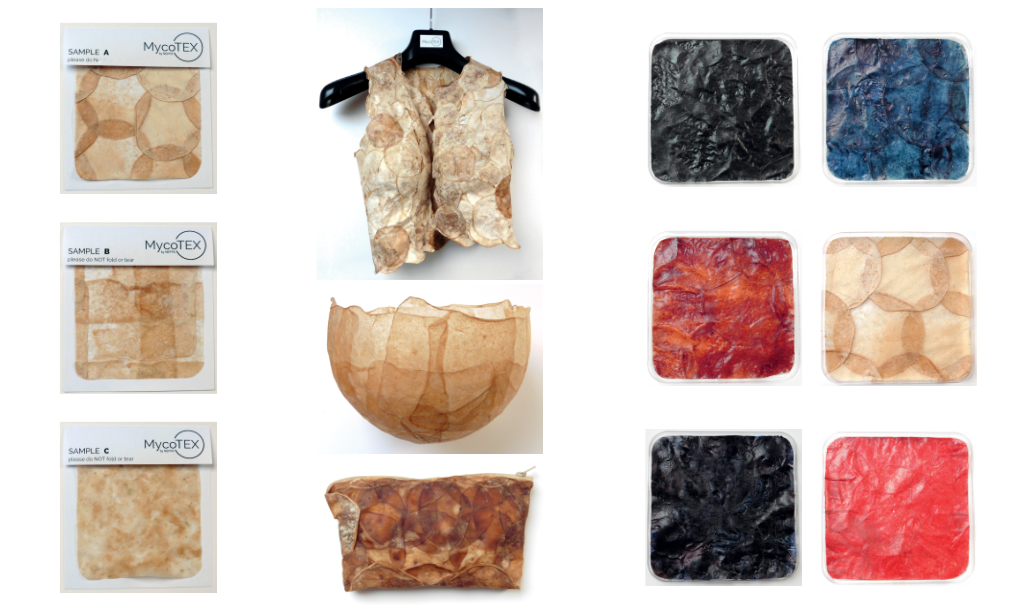
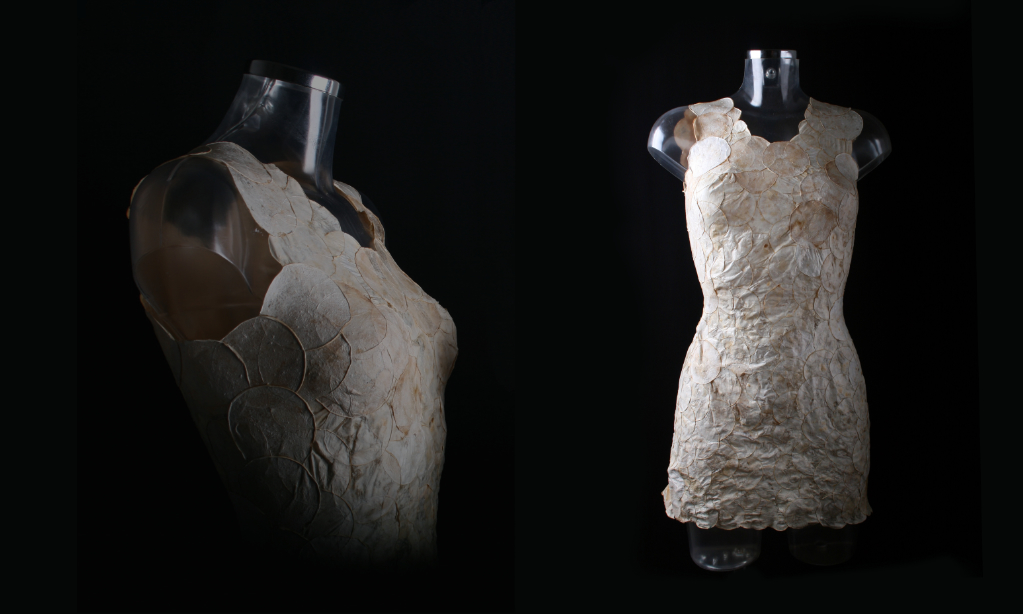
The piece that started everything was a simple dress made from Petri-dish grown mycelium pieces: circular and square sections of the material assembled into a clean silhouette. The simplicity was intentional: I wanted the material itself to be visible and legible, not hidden by complex construction.
Consumers consistently responded most warmly to the textured, organic versions of the material; the ones that looked genuinely new, that had a surface quality unlike anything currently in fashion. Those were their favourites. They found them interesting, beautiful, different.
When I spoke to brands, the feedback was almost exactly the opposite. They wanted the material smoother. More like leather, or like a familiar fabric. Something they recognised and knew how to sell.
I understood the commercial logic. But I disagreed with the conclusion. Why make something that already exists? The whole point of developing a new material is to add something to the palette, not to create a worse version of what is already available. I had to hold that line repeatedly, for years, against significant commercial pressure. Only in the last two or three years have I started hearing other material developers articulate the same position: stop mimicking existing materials, start creating genuinely new ones.
“Consumers loved the textured, organic surfaces. Brands always wanted it smoother, more like what they already knew. I understood the logic. I still disagreed. Why make a new material that looks like an old one?”
The material specs absurdity
There is a related frustration I have carried for years, and have raised at panels and in industry discussions without ever receiving a satisfying answer.
New materials entering the fashion industry are tested against performance standards like tensile strength, tear resistance, abrasion resistance, and so on. These standards vary significantly between brands. What I have found repeatedly, and cannot fully explain, is that fast fashion brands often require higher material specifications than luxury brands.
Think about what that means. A garment that will be worn on average seven times before being discarded is being tested to a higher physical standard than one designed to last a decade. The only partial explanation I have ever heard is that fast fashion items need to survive industrial production processes (high-speed machinery, tight handling) and the material must be strong enough for that. Which is plausible. But it does not explain why luxury brands producing mass items in factories would require less.
I think what it actually reveals is that there is no coherent system underlying these standards. They evolved brand by brand, buyer by buyer, without reference to any principle about how long a garment is expected to last or how it will be used. We are applying nineteenth-century material standards to a twenty-first century consumption reality.
This matters for material innovation. If you are developing a new biomaterial designed for a two-year lifecycle, being asked to meet specifications designed for a garment expected to last twenty years is not just commercially frustrating, it is conceptually incoherent. We need a new standard: a minimum viable specification for new materials, calibrated to actual use, not inherited convention.
The effort paradox, and why co-design changes everything
There is one more piece of psychology worth naming here, because it points toward a practical solution.
Research on what psychologists call eudaimonic wellbeing (the deep satisfaction that comes from effort, meaning, and growth) consistently shows that people value things more highly when they have invested effort in their creation. This is the IKEA effect: the furniture you assembled yourself is worth more to you than the identical pre-built piece, because your effort is now inside it.
For fashion, this has a direct application. A garment that the wearer has participated in designing (through co-design, personalisation, or even just active engagement with meaningful choices about fit and form) is more likely to be kept, cared for, and valued over time. The process of making is not just a production method. It is a value-creation mechanism.
This is why personalisation matters to me beyond commercial logic. The jacket I described in my first article “The jacket with the tropical leaves that I have worn for twenty years” is valued precisely because of what it does to me and what it has been through with me. That relationship took time to build. But a production system that starts with your body, your choices, and your measurements creates the conditions for that relationship from the first wearing.
Where this leads, and the cliff-hanger I promised
The idealistic approach to restoring value in fashion – make people care more, buy less, choose better – is not wrong. It is insufficient. It reaches the already-converted and asks too much of everyone else.
The more interesting question is not “how do we restore the old values of clothing?” but “what does value look like in a fashion system designed for how people actually live?” That requires letting go of some assumptions the sustainability world holds dear.
In my next article I will share a framework I have been developing. One that I expect will be uncomfortable for some people in sustainable fashion. It takes the reality of fast consumption seriously, not as a problem to be solved but as a starting point for design. And it proposes a new set of values for fashion that I think are more honest, more useful, and ultimately more effective than the ones we have been working with.
It will step on some toes. It stepped on mine, when I first followed the logic to its conclusion.
Ready to build the material future?
I work with brands, research organisations, and investors serious about making the transition real, not just talking about it.
Let’s Collaborate